
[VIDEO] Sport Leadership Doesn't Have an Opportunity Problem. It Has a Capability Problem.
A few years ago, midway through a session on the Pro Sports Assembly course, one of the participants - a department head responsible for a large stadium operation - said something I've thought about ever since.
"I don't need another performance dashboard. I need to know what to do with the one I already have."
She wasn't short of data. Her organisation had invested heavily in it. She wasn't short of ambition, or effort, or intelligence. What she was short of was a leadership repertoire wide enough for the job she was now doing, a job that had grown considerably more complex in the two years since she'd started it, while the way she'd been trained to lead hadn't grown with it.
I've now worked with leaders across all major sports franchises (football, baseball, basketball, hockey, soccer, golf, tennis and hockey). organisations for five years through Pro Sports Assembly, and that moment repeats itself in different forms almost every season. Talented people, well-resourced organisations, real opportunity in front of them and a quiet, rarely-named gap between what the role now demands and what they were ever equipped to do.
What's actually happening across the industry
It would be easy to assume sport's biggest challenge right now is a shortage of opportunity. The evidence says otherwise. PwC's 2026 Global Sports Survey (drawing on over 500 senior executives across 48 countries) points to sustained growth across women's sport, digital media, live experience and private investment. Deloitte's 2026 Global Sports Industry Outlook describes a sector actively experimenting with AI, new ownership models and stadium-led real estate. Capital is arriving. Audiences are expanding. Technology is more accessible than at any point in the industry's history.
What this actually reveals
Put these signals together and a pattern emerges that's more significant than any single one of them: sports organisations are commercialising before their data is trustworthy, adopting AI before redesigning the work around it, accepting new capital before strengthening the governance to handle it, and expanding calendars before resolving the welfare questions those calendars create.
I'd call this the sports leadership capability gap the distance between the complexity of the organisation a leader is now required to run, and the decision-making capability currently available to run it.
It's a distinction worth sitting with. Technology will keep getting easier to acquire. Capital will keep finding attractive properties. Content will keep getting cheaper to produce. None of that is where the scarcity is anymore. The scarcity is in the capability to integrate all of it, to make credible calls, sequence change well, and do it without burning through the trust of players, staff or fans in the process.
What leaders actually need to be capable of
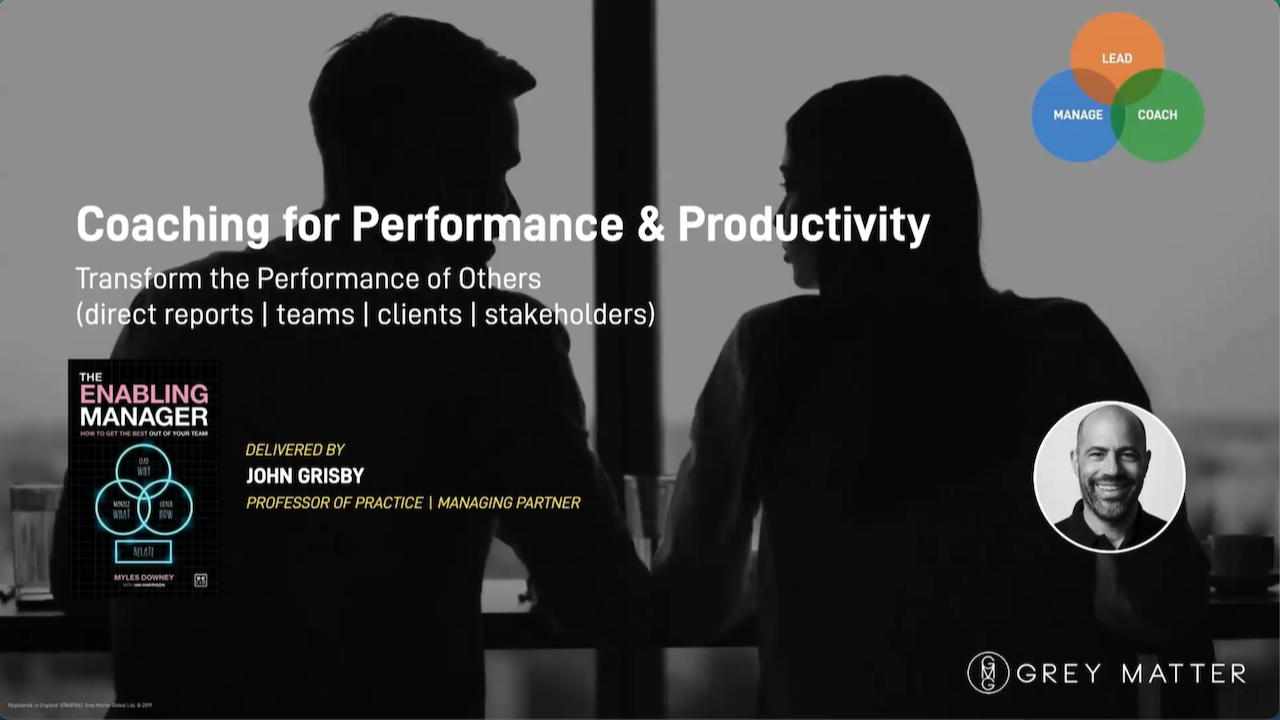
This is where the stadium operations lead's comment earns its place in the story. Her problem was never information. It was knowing, in a given moment, whether the situation in front of her called for direction, for management, for coaching, or simply for the kind of relationship that makes any of the other three land. Myles Downey's Enabling Manager framework - the foundation of the Coaching for Performance & Productivity work I deliver through Pro Sports Assembly - calls this repertoire Lead, Manage, Coach, Relate. Most leaders default to whichever one they're most comfortable with, regardless of what the moment actually requires. That mismatch, repeated daily across an organisation, is what a capability gap looks like in practice, not a dramatic failure, just a steady mismatch between demand and repertoire.
The question worth taking back to your own organisation
If your organisation is investing in AI, chasing new revenue, courting new capital or expanding into new markets, the strategy almost certainly assumes a level of leadership capability underneath it. Few organisations have actually established whether that capability exists.
That's a more useful question than "what tool should we adopt next." It's the one I'd put to any sports executive right now: as your organisation's complexity grows, is your leaders' capability to move between leading, managing, coaching and relating growing with it — or is everyone simply working harder inside a repertoire that was built for a simpler job?
I'll be returning to Pro Sports Assembly this season to keep testing that question in practice, with a new cohort of leaders across the league offices, franchises and venues doing exactly this work in real time. What I keep learning from them is that the answer is rarely about talent. It's about whether anyone has ever deliberately built the range they now need.
Watch the video: https://youtu.be/yg6BMB8R_Rk
Stay connected with news and updates!
Join our mailing list to receive the latest news and updates from our team.
Don't worry, your information will not be shared.
We hate SPAM. We will never sell your information, for any reason.
Author