
Change Isn’t One Thing. It's Everything at Once [WATCH VIDEO]
The biggest misunderstanding about change is that it’s a single event.
In reality, most organisations are navigating several types of change simultaneously often without recognising the different leadership capabilities each one requires.
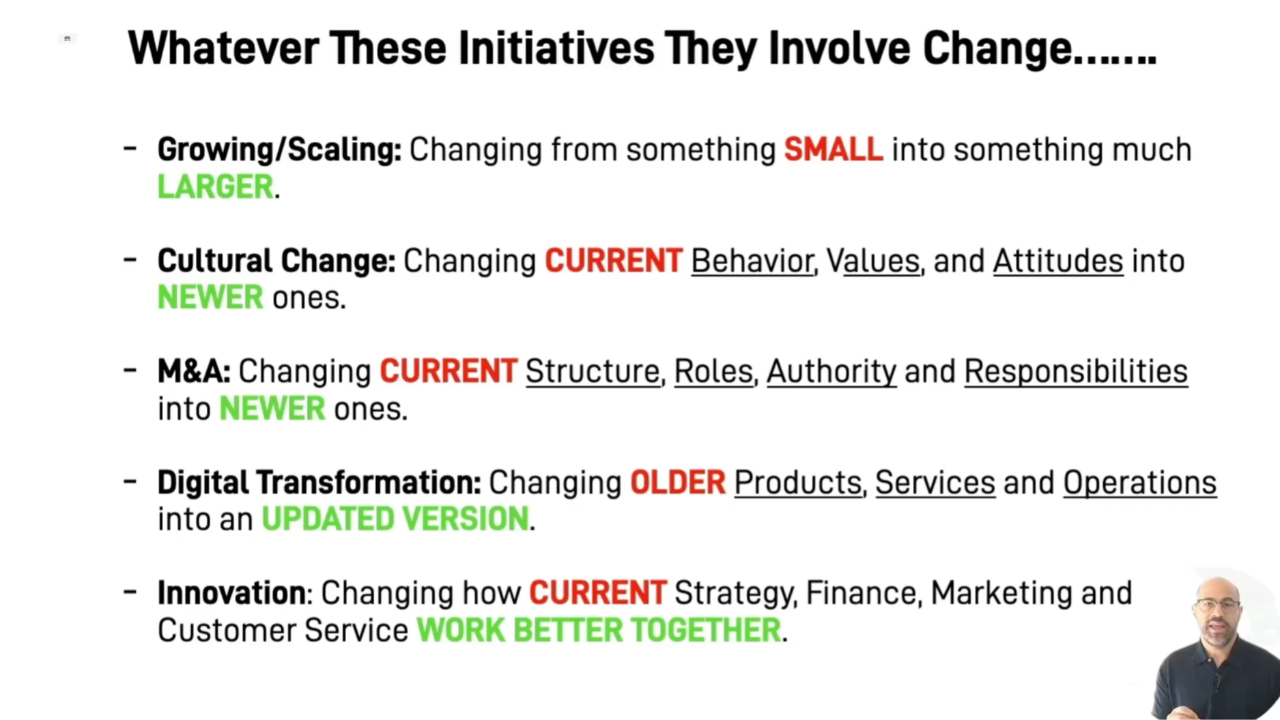
When leaders talk about growth, digital transformation, or innovation, they’re often describing different expressions of the same underlying force: transformation through change.
Understanding these distinctions matters. Because each form of change reshapes structure, behaviour, and performance in different ways.
Scaling: Operational Change
Growing a business isn’t simply about doing more.
Scaling requires moving from a smaller operational model into something structurally larger — new systems, new rhythms, and new expectations.
What worked when a team was small rarely survives at scale.
Leadership shifts from individual execution to system design.
The real question becomes:
How do leaders maintain clarity while complexity increases?
Cultural Change: Behavioural Transformation
Culture isn’t a statement — it’s behaviour repeated over time.
When organisations attempt cultural change, they are effectively asking people to move from familiar attitudes and habits into new ways of working.
That shift demands more than communication. It requires:
-
modelling new behaviours
-
aligning incentives
-
and reinforcing performance standards through daily leadership practice
Without capability, culture initiatives remain aspirational rather than operational.
M&A: Structural Change
Mergers and acquisitions rarely fail because of financial models.
They fail because structure changes faster than people adapt.
Roles, authority, and decision rights are reshaped overnight.
Leaders must redefine:
- Who decides
- How teams collaborate
- Where accountability sits
This is less about integration plans — and more about leadership clarity.
Digital Transformation: Operational Reinvention
Digital transformation isn’t simply replacing old tools.
It changes how products, services, and workflows operate.
Leaders must guide teams through:
Uncertainty around new systems
Evolving roles
Shifts in performance expectations
Technology accelerates the change, but leadership capability determines whether adoption becomes progress or resistance.
Innovation: Strategic Alignment
Innovation is often misunderstood as creativity.
In reality, it’s coordination.
Strategy, finance, marketing, and customer experience must begin working as an integrated system rather than isolated functions.
That requires:
- Clear decision-making
- Shared language across teams
- Leaders capable of aligning diverse priorities
Innovation succeeds when leadership creates coherence — not just new ideas.
The Takeaway
Change isn’t a single initiative.
It’s a collection of leadership shifts happening simultaneously:
- Scaling
- Culture
- Structure
- Digital transformation
- Innovation
The organisations that thrive are not those with the most change programmes — but those with leaders capable of navigating complexity with clarity.
▶️ Watch here: https://youtu.be/Ow642ogojTU?si=2YpbKWODZInQr3CO
Stay connected with news and updates!
Join our mailing list to receive the latest news and updates from our team.
Don't worry, your information will not be shared.
We hate SPAM. We will never sell your information, for any reason.
Author