
AI Is Making Human Leadership More Valuable, Not Less
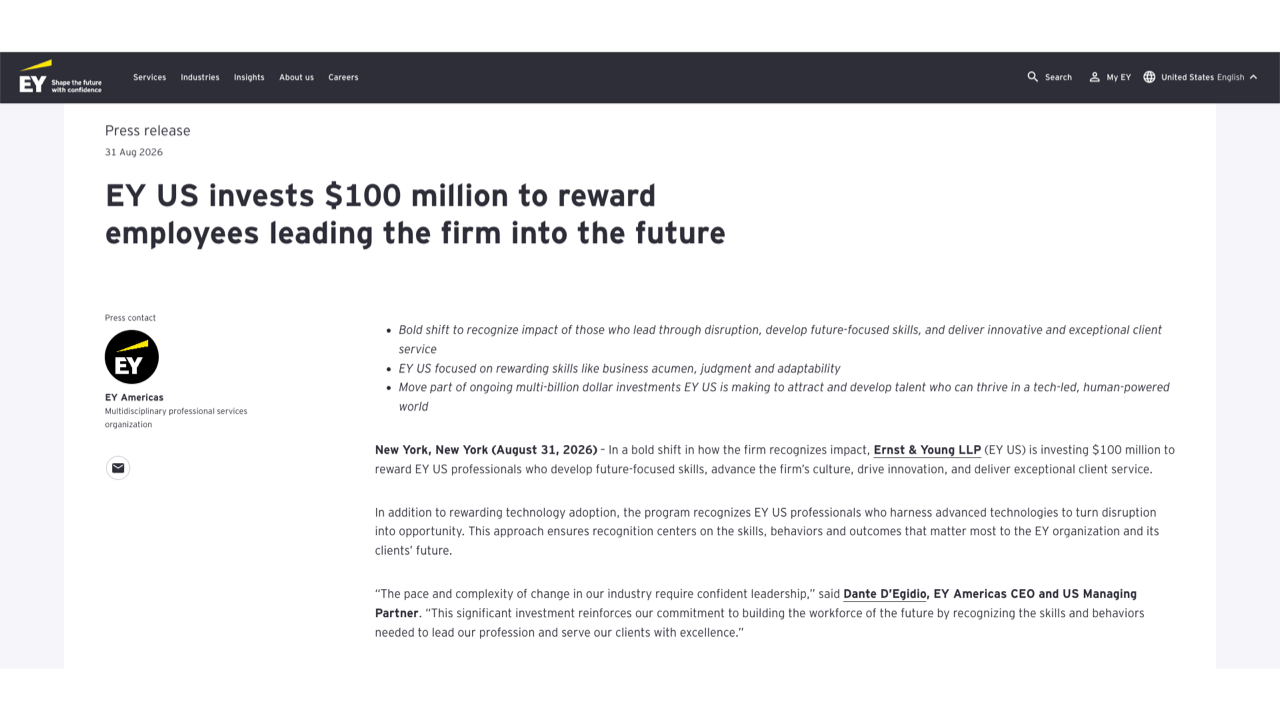
“The pace and complexity of change in our industry require confident leadership.”
- Dante D’Egidio, EY Americas CEO and US Managing Partner
EY has just made a $100 million bet on the future of work.
What makes the investment interesting is that it isn't simply another investment in artificial intelligence. EY US is rewarding people who demonstrate future focused capabilities including business acumen, judgement, adaptability, learning, collaboration and leadership and who turn those capabilities into measurable results.
At a time when organisations are asking what AI will replace, EY raises a more important question:
What becomes more valuable because of AI?
I believe leadership capability is part of the answer.
The AI Leadership Paradox
Artificial intelligence can increasingly analyse, research, model, draft, code, summarise, automate and recommend. But greater technological capability does not automatically create greater organisational capability. In many organisations, it creates a new challenge.
As AI increases speed, information and choice, leaders must interpret more complexity, exercise judgement faster and lead people through more frequent change.
The technology becomes more capable. So must the leader.
That is the AI Leadership Paradox:
The more technologically capable organisations become, the more important high-quality human leadership capability becomes.
Stop Calling the Hardest Capabilities “Soft”
EY's announcement highlights capabilities such as:
Business acumen. Judgement. Adaptability. Learning. Collaboration. Leadership.
We still sometimes call these “soft skills”. That description increasingly makes little sense. Making a major decision with incomplete information isn't soft. Neither is managing poor performance, influencing without authority, leading people through restructuring or recognising when an AI recommendation is technically useful but organisationally wrong.
These are leadership capabilities. And AI may make them more valuable, not less.
Bill Gates and the Idea of “Human Reserved”
Bill Gates recently introduced another useful idea into the AI debate: “Human Reserved.”
His argument is that as AI and robotics become increasingly capable, society may deliberately decide that some activities should remain human-led. Not because machines are incapable of performing them, but because something valuable would be lost if humans were removed. Gates uses the natural human resource as a powerful example.
For leaders, the wider implication is significant. AI may increasingly reproduce knowledge and perform tasks, but judgement, trust, empathy, context, accountability and human relationships remain fundamentally important to how organisations function.
From Skills to Capability
EY's recognition system has three levels:
- Everyday leadership: learning, experimentation, collaboration and leadership in the moment.
- Transformation that drives measurable results: using innovation, technology and disruption to create meaningful change.
- Game-changing enterprise impact: creating lasting organisational impact.
EY doesn't call this a capability model. But viewed through that lens, the progression is compelling:
Behaviour → Application → Organisational Impact.
That distinction matters.
A skill can be learned. Capability is the ability to bring knowledge, skills, experience, judgement and behaviour together and apply them effectively in context.
Someone may understand coaching. But a capable leader knows when to coach rather than direct, conducts the conversation effectively, adapts when circumstances change and ultimately improves performance.
That is what organisations need.
The Leadership Capability Gap
AI also exposes a growing organisational problem.
On one side:
AI capability ↑
Technology capability ↑
Speed of change ↑
Organisational complexity ↑
On the other:
Leadership capability →
The space between them is the Leadership Capability Gap.
Buying more technology does not close it. An organisation can deploy advanced AI while its leaders remain unable to manage performance, redesign work, solve cross-functional problems, lead transformation or translate strategy into execution.
AI transformation therefore cannot simply be technology transformation. It must also be leadership transformation.
The $100 Million Signal
EY's announcement should not be interpreted simply as evidence that “soft skills are making a comeback.” Something larger may be happening. EY describes the future as “tech-led, human-powered.”
That may be exactly the right way to think about it. AI is not making human leadership obsolete. It may be making exceptional human leadership considerably more valuable. And that leaves organisations with one critical question:
As the technology becomes more capable, are our leaders becoming more capable with it?
Read the article:
https://www.ey.com/en_us/newsroom/2026/08/ey-us-to-reward-employees-leading-firm-into-future?utm_source=substack&utm_medium=email
Stay connected with news and updates!
Join our mailing list to receive the latest news and updates from our team.
Don't worry, your information will not be shared.
We hate SPAM. We will never sell your information, for any reason.
Author